Anthropic Computer Use Production: The Claude Code Precedent
Anthropic's computer-use API shipped beta Oct 2024. Production deployments 2025-2026 include Claude Code, Browser-Use derivatives, Airbnb, Amazon, enterprise pilots. Narrow well-scoped tasks succeed; open-ended agent workflows still struggle in production.
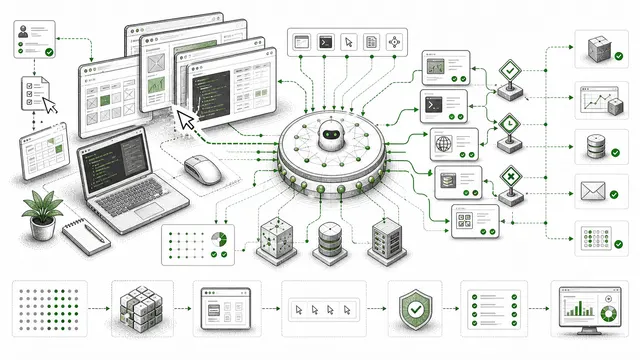

Anthropic shipped its computer-use API in beta in October 2024. The capability — letting Claude observe screenshots and produce mouse, keyboard, and scroll actions — was the first foundation-model release that explicitly targeted browser and OS agent workloads. Eighteen months later, the production deployment pattern is clear: narrow, well-scoped tasks succeed; open-ended agent workflows still struggle. The single largest production proof-point is Claude Code, Anthropic’s own CLI tool — which uses many of the same primitives that the computer-use API exposes, applied to terminal-based coding work.
The Claude Code precedent matters because it demonstrates what production-grade computer-use looks like at scale. Hundreds of thousands of developers use Claude Code daily; the reliability bar is the bar that production deployment requires; the architectural choices that make it work are visible in the rest of the production-deployment landscape.
What Claude Code shows
Claude Code’s production architecture demonstrates several patterns that have become canonical for production agent deployment.
Narrow tool surface. Claude Code exposes a defined set of tools (read file, write file, run command, search, browse) rather than open-ended computer-use. The narrow surface makes the agent’s actions predictable and auditable. Production deployments that ship with open-ended computer-use (e.g., experimental “run any command” configurations) consistently underperform configurations with a fixed tool set.
Tight feedback loops. Every tool call returns structured output that the agent can verify before continuing. File-edit operations return the resulting diff. Command executions return exit codes plus output. The agent does not blindly proceed — it checks each action’s outcome.
Human-in-the-loop checkpoints. Claude Code defaults to asking for user confirmation before destructive operations (file deletion, force-push, configuration changes). The production deployments at Anthropic and at enterprise customers maintain similar checkpoint patterns. Pure-autonomous agent loops — where the agent decides everything without checkpoints — are rare in production.
Cost-conscious model routing. Claude Code uses different model tiers for different operations. Simple file lookups run on faster models; complex multi-file refactoring runs on reasoning-tier. The cost-vs-capability routing is built into the product, not bolted on by users.
These four patterns recur across the other production computer-use deployments visible in 2026.
Other production deployments
Airbnb’s customer-service agent (publicly disclosed Q3 2025). Uses computer-use to handle multi-step customer-service workflows that previously required human agents. Scoped to specific task types; runs with checkpoints on customer-impacting actions; uses tiered model routing. Reported productivity gains of 30-40% on covered task types.
Amazon’s Q for internal workflows (announced re:Invent 2025). Uses computer-use for internal-tool automation across procurement, HR, and IT operations. Scoped narrowly per workflow; runs as part of broader Amazon Q product family. Detailed production metrics not public.
Enterprise pilots in regulated industries. Financial services and healthcare buyers have piloted computer-use deployments for internal-tool automation (claims processing, intake workflows, compliance reporting). The pilot phase has lasted longer than initially planned because reliability requirements in regulated industries are higher; the production rollouts are still partial.
Browser-Use and Stagehand derivatives. Open-source frameworks that wrap computer-use API for browser-specific workflows. These have hundreds of production deployments across mid-market customers, primarily for competitive intelligence, lead enrichment, and content monitoring.
The pattern across these deployments: success correlates with narrow scope, tight feedback loops, checkpointing, and tiered routing. Failure correlates with open-ended scope, blind execution, and single-model configurations.
What doesn’t work yet
Three classes of production deployment have consistently struggled in 2024-2026.
Open-ended browse-and-do workflows. “Browse the web and do my Christmas shopping” — the consumer-facing “personal assistant agent” use case — does not work reliably. The error rate compounds across the open-ended task chain. Anthropic’s own demos and OpenAI’s Operator demos have shown this convincingly. The capability exists in narrow form; the open-ended form does not work at production reliability.
Adversarial-target scraping. A computer-use agent trying to scrape a defended target (Booking, LinkedIn, Instagram) at production volume gets caught by behavioral and device-graph anti-bot defenses. The agent’s actions are detectable as non-human, and the defenses do not care that the agent is “well-behaved” — they care that it is automated. The travel-scraping economics show what this looks like in practice.
Long-horizon workflows. Tasks that require multi-day execution (research projects, sustained monitoring, complex multi-stage workflows) hit failure modes that the per-task feedback loop does not catch. Recovery from errors that happened hours or days earlier is structurally hard. The WebArena benchmark measures a thin slice of this; production workloads are even harder.
What the production pattern predicts
The combination of what works and what does not gives a clear template for the next 12-18 months of computer-use deployment.
Continued growth in narrow, well-scoped workflows. Customer service, IT operations, internal-tool automation, software engineering assistance. Each of these has the structural properties that make computer-use succeed: bounded task surface, observable outcomes, recoverable errors, clear human-checkpoint placement.
Slower growth in open-ended consumer workflows. The Operator/Mariner consumer demos continue to attract attention but production usage remains low. The reliability bar for consumer-facing agents is high (consumers do not tolerate the 20-point production gap that enterprise workflows accept), and the failure modes are user-visible in ways that enterprise failures are not.
Adversarial scraping stays specialized. The Apify Store and specialized scraping infrastructure continue to absorb the workloads that need to defeat anti-bot defenses. Direct computer-use against defended targets is the wrong tool for that job. The combination of “Claude Code-style well-scoped agent” plus “Apify-style specialized scraping tools” via MCP integration is the production architecture that scales.
For Apify publishers and other scraping-infrastructure providers, the implication is that the computer-use API is not direct competition for most use cases. It is complementary infrastructure — the agent layer that orchestrates calls to the specialized tools. The MCP-era integration pattern is where the production economics actually sit, and the computer-use API is one of several agent-side capabilities feeding into that integration.
The longer-term shape: computer-use becomes the default agent capability layer, narrow-scope deployments continue expanding rapidly, open-ended deployments remain experimental until reliability infrastructure catches up. Claude Code’s production scale is the existence proof that the narrow-scope approach works. The rest of the deployment landscape is rebuilding around the same pattern.
Sources